







The word Copt is an English word taken from the Arabic word Gibt or Gypt. It
literally means Egyptian. The Arabs, after their conquest of Egypt in 641 AD, called
the population of Egypt Gypt, from the Greek word “Egyptos” or Egypt. The Greek
word “Egyptos” came from the ancient Egyptian words (Hut-Ka-Ptah), one of the
names for “Memphis”, the first capital of Ancient Egypt. In contemporary usage, the
term "Coptic" refers to Egyptian Christians. Today, Copts form almost 13% to 15% of
Egypt’s population though they are not ethnically distinct from other Egyptians as
they are fully integrated into the body of the modern Egyptian nation.
In 1992, there were over nine million Copts (out of a population of some 57
million Egyptians) who pray and share communion in daily masses in thousands of
Coptic Churches in Egypt. This is in addition to another 1.2 million immigrant Copts
who practice their faith in hundreds of churches in the United States, Canada,
Australia, Britain, France, Germany, Austria, Holland, Brazil, and many other
countries in Africa and Asia. Inside Egypt Copts live in every province though in no
one of these provinces are they a majority.
The history of the Coptic Church in Egypt is basically the history of Christianity
in Egypt, for the current Coptic Church is a direct evolution from those earlier times.
However, it traditionally begins with the visit of the Holy Family to Egypt. Copts
relate that the blessing of Christianity on their country goes back to the days when
Jesus was a young boy. The holy family, consisting of the baby Jesus, Mary and
Joseph traveled to Egypt and lived there for some time. Numerous traditions exist
about the exact locations that the holy family visited and many take annual
pilgrimages following this route (it is also a popular tourist route) However,
historically it was Saint Mark the Evangelist, during the first century AD, who actually
is considered to be the founder of the church. He preached and suffered martyrdom
in Alexandria around the time that Nero ruled Rome.
When St. Mark died in Alexandria in year 68 AD, his body was buried in the
chapel at “Beucalis”. In the year 828, the remains were stolen and placed in the
Venice cathedral. In 1968 the largest cathedral in Africa was built in Cairo, St. Mark's
Coptic Cathedral. Before the cathedral was finished Pope Paul VI returned to Egypt
the body of St. Mark, at the reign of pope kerolos 6th. With much ceremony this was
placed in a grave beneath the main altar. Nowadays, weekly meetings are held there
where the pope addresses the crowds.
The early Christians of Egypt suffered considerably at the hands of the early
Roman pagans, as did others prior to The rule of the Roman emperor, Constantine,
who not only legalized their faith, but encouraged it as a Christian himself.
However, in 451 AD the Fourth Ecumenical Council took place, and would divide
the Catholic, or "universal" Christian church. The decisions of this council concerned
the nature of Jesus Christ.
The Chalcedonian definition states that Jesus Christ is indeed the Logos
incarnate, the very Son of God "born of the Father before all ages." It affirms that
the Virgin Mary is truly Theotokos since the one born from her "according to the
flesh" in Bethlehem, is the uncreated, divine Son of God, one of the Holy Trinity. In
His human birth, the Council declared, the Word of God took to Himself the whole of
humanity, becoming a real man in every way, but without sin. Thus, according to the
Chalcedonian definition, Jesus of Nazareth is one person or hypostasis in two natures
- human and divine. He is fully human. He is fully divine. He is perfect God and
perfect man. As God, He is "of one essence" (homoousios) with God the Father and
the Holy Spirit. As man, He is "of one essence" (homoousios) with all human beings.
However, it should be pointed out that, officially, the Coptic Church has never
believed in monophysitism the way it was portrayed in the Council of Chalcedon.
According to a statement by the Coptic Church:
"Copts believe that the Lord is perfect in His divinity, and He is perfect in His
humanity, but His divinity and His humanity were united in one nature called "the
nature of the incarnate word", which was reiterated by Saint Cyril of Alexandria.
Copts, thus, believe in one nature from 2 natures human and divine "without
mingling, without confusion, and without alteration" (from the declaration of faith at
the end of the Coptic divine liturgy).
These two natures "did not separate for a moment or the twinkling of an eye"
(also from the declaration of faith at the end of the Coptic divine liturgy)."
This split in the church ended up taking the form of persecution against the
Coptic Christians of Egypt. After having survived the persecution of the Roman
Pagans, they were once again besieged, now by other Christians. Hence, when the
Arabs invaded Egypt in the mid-seventh century AD, they met little resistance form
the native Christian population.
The Coptic Christian church of Egypt has been responsible for at least several
major contributions to the universal Christian faith. Perhaps best known is the
founding of monastic establishments. Even before Christianity, it was not uncommon
for young Egyptians to retire to the desert for seclusion, perhaps because of the
harsh treatment of the Egyptians by the early Romans. Later, with the advent of
Christianity, Christians also took to the desert for solitary spirituality and as this
movement evolved over time, they sought out like minded individuals, eventually
forming themselves into monastic communities. Hence, Egypt is known as the birth
place of Christian monasteries.
Another outstanding contribution was the Didascalia, the famous catechetical
school in Alexandria where early Christian scholars labored to prove that reason and
revelation, philosophy and theology were not only compatible, but also essential for
each other's comprehension. This was the first Catechetical School in the world. The
first great scholar who served as head of the Didascalia was Pantaenus, who
probably ran the school for about a 20 year period between 180 and 200 AD.
However, probably the most important theologian and prolific author associated with
the school was Origen.
After the invasion of the Arab Muslims around the middle of the seventh
century AD, the church suffered a slow decline but around the middle of the
twentieth century, it experienced an unprecedented revival. This spiritual renaissance
had its start in the forties and fifties in the Coptic Sunday School movements in
Cairo, Giza and Asyut. Inspired by the challenges they experienced in the Sunday
School classes, young men consecrated their lives to God and joined the desert
fathers. Today, many of the church leaders grew from that spirited revival. The Copts
continue to have active youth groups that emphasize religious education as well as
providing social interaction. Although called Sunday schools, these gatherings usually
held on Fridays, are considered to be a very important religious element to all the
Coptic families. Their children usually join at an early age and continue to participate
in them throughout their adolescence. They involve diverse activities, both on the
spiritual level as well as on the social side of their lives.
Today, the Coptic church has spread throughout the world, with churches in
many different countries. Under the patronage of the current people, the church
holds a deep and profound interest in erasing the prior concepts of the church among
world. The church today maintains communications with the Roman Catholic church,
as well as others, and it is clear that the desire of the Copts is to be fully and
unequivocally accepted as orthodox Christians by all members of the Christian world
community.
The Coptic Church of the diaspora is a new and dynamic development of the
second half of the twentieth century. Recent missionary efforts of the Coptic Church
in Africa have led to the establishment of numerous churches in Zambia, Kenya,
Zaire, Zimbabwe, Namibia and South Africa. The Coptic Church is even spreading
throughout the United States.
The Coptic Orthodox Church's clergy is headed by the Pope of Alexandria, Pope
Shenouda III. For hundreds of years Alexandria, the second city of Egypt, was the
home of the Pope but today his Cathedral is in Cairo.
Both the Pope and the Bishops that regularly oversee the priests ordained in
their dioceses and matters of faith, must be monks. As for the priests, they must be
married and must attend the Catechetical School before being ordained. Today, there
are over 60 Coptic Bishops governing dioceses inside Egypt as well as outside, such
as Jerusalem, Sudan and Western Africa.
The Holy Synod is the highest ecclesiastical body in the church and is
responsible for the church's spiritual, ecclesiastical, structural, organizational and
economic affairs. It is made up of all the members of the Coptic episcopate, which
today include seventy-eight metropolitans, bishops and the wakil al-batrakiya, an
archpriest representing the married clergy. Though this body has functioned since
the fourth century, in 1985 a constitution for the Holy Synod was drafted, setting out
its objectives, policies and procedures. To make it more effective, Pope Shenouda III
divided the Holy Synod into seven subcommittees that deal with pastoral affairs,
liturgical affairs, ecumenical relations, monastic affairs, faith and ethics, and
diocesan affairs. The body of the Holy Synod convenes annually on the Saturday
prior to Pentecost Sunday in the Chapel of Saint Antony in the Pontifcal Residence in
Cairo.
There are two other non-clerical bodies who participate in taking care of
Church affairs. The first is a popularly-elected Coptic Lay Council, which appeared on
the stage in 1883 A.D. to act as a liaison between the Church and the Government.
The second is a joint lay-clerical committee, which appeared on the stage in 1928
A.D. to oversee and monitor the management of the Coptic Church's endowments in
accordance with the Egyptian laws.
The Coptic calendar has thirteen months, twelve with thirty days each and an
intercalary month at the end of the year which has five or six days depending on
whether the year is a leap year or not. The year starts on September 11th in the
Gregorian Calendar or on the 12th in the year before (Gregorian) Leap Years. The
Coptic Leap Year follows the same rules as the Gregorian so that the extra month
always has six days in the year before a Gregorian Leap Year. The names of the
months and their starting dates are as follows:
Modern Pronunciation
Start Date
Start Date Leap Year
Tout
11 Sept
12 Sept
Baba
11 Oct
12 Oct
Hator
10 Nov
11 Nov
Kiahk
10 Dec
11 Dec
Toba
9 Jan
10 Jan
Amshir
8 Feb
9 Feb
Baramhat
10 Mar
-
Baramouda
9 Apr
-
Bashans
9 May
-
Paona
8 Jun
-
Epep
8 Jul
-
Mesra
7 Aug
-
Nasie
6 Sep
-
The Coptic calendar, the oldest in history, originated three millennia before
Christ. The exact date of its origin is unknown. It is believed that Imhotep, the
supreme official of King Djoser C.2670 BC. had a great impact on the construction of
the calendar.
Copts observe seven canonical sacraments: Baptism, Christmation
(Confirmation), Eucharist, Confession (Penance), Orders, Matrimony, and Unction of
the sick. Baptism is performed few weeks after birth by immersing the whole body of
the newborn into especially consecrated water three times. Confirmation is
performed immediately after Baptism. Regular confession with a personal priest,
called the father of confession, is necessary to receive the Eucharist. It is customary
for a whole family to pick the same priest as a father of confession, thus, making of
that priest a family counselor. Of all seven sacraments, only Matrimony cannot be
performed during a fasting season. Polygamy is illegal, even if recognized by the civil
law of the land. Divorce is not allowed except in the case of adultery, annulment due
to bigamy, or other extreme circumstances, which must be reviewed by a special
council of Bishops. Divorce can be requested by either husband or wife. Civil divorce
is not recognized by the Church. The Coptic Orthodox Church does not have and
does not mind any civil law of the land as long as it does not interfere with the
Church's sacraments. The Church does not have (and actually refuses to canonize)
an official position vis-a-vis some controversial issues (e.g. abortion). While the
church has clear teachings about such matters (e.g. abortion interferes with God's
will), it is the position of the Church that such matters are better resolved on a case-
by-case basis by the father of confession, as opposed to having a blanket canon that
makes a sin of such practices.
The main Coptic Services, like those of most other Christian churches, are held
on Sundays. The service usually starts at 6.00 am or 6.30 am and lasts from four to
six hours depending on each church and its priests. Depending on the church
(particularly the size of the congregation), there may be one or more priests, as well
as a number of altar boys. Each may have a certain rank within that particular
church.
The service is composed of four parts. The first is the preparation prayer, called
in Arabic the early morning prayer. This lasts only 30 minutes. .the alter boys go
around with incenses while chanting in the Coptic language.
The second part is for offering, at which point a prayer is said over the holy
bread. This lasts for 20 to 30 minutes.
The third part consists of the preaching mass. Here, the priests read sections of
the Old and New Testament, as well giving a sermon. The name of this part dates
back to the old Roman times when elder people wanted to convert to Christianity.
They had to attend the mass as listeners only for three years as a trial before they
could participate and have communion. In Arabic it is called " Kodass al Mowaezin".
Kodass is Arabic for mass.
The fourth part is the reconciliation prayer. This only lasts for 10 minutes when
the priests give the people Christ's forgiveness and the people do so to each other
The fifth part is the Believer's mass and it lasts for the rest of the service. This
is when the congregation has communion, and is supposed to be only attended by
those who have been baptized and who have confessed. This strict rule is now more
found in small villages in Upper Egypt, but in Cairo, one must only hear the Bible
reading to be able to have communion, meaning that one cannot enter very late to
the service.
During the service women and men don't mix, they sit separately on each side
of the church . Also during communion, they go to different chambers on the sides of
the alter where the women cover their hair in respect of the ceremony. While the
seating is separated for women and men during Sunday services and also funerals,
during wedding they may sit together.
Unlike the Catholic Church, Coptic Orthodox Christians celebrate Christmas on
the 7th of January which was very recently made an official holiday in Egypt as a
token of the nation’s unity. This date corresponds to the 29th day of the Coptic
month, “Kahk”.
The biggest Nativity service is held by the Pope in Saint Mark's Cathedral in
Cairo. The Coptic language, now almost extinct, is only used in mass ceremonially.
After the service, families go home to break their fast. Copts make special sweet
biscuits for Christmas, which is the same “Kahk” as the Muslims make for “Eid El-Fitr
“(little Bairam
A kind of rare tradition is also found in the Egyptian Coptic Church. Holy bread,
called “Qurban”, which is distributed after the service in the church. “Qurban” bread
is round, decorated with a cross in the middle that is surrounded by twelve dots. The
dots represent the twelve disciples of Jesus. It is very common for people visiting
each other after mass to offer some and normally it can never be refused.
The Copts have more seasons of fasting than Christians from any other
tradition. Out of the 365 days of the year, Copts fast for over 210 days. During
fasting, no animal products (meat, poultry, fish, milk, eggs, butter, etc.) are allowed.
On a more strict level, no food or drink whatsoever may be taken between sunrise
and sunset as they should only break their fast after communion.
Fasting seasons of the Coptic Church include, the Fast of the Nativity
‘Christmas’ which is 45 days, the Fast of the Apostles, the Fast of the Virgin Mary,
the Fast of Nineveh and of course Lent, known as “the Great fast” lasts 55 days.
The Holy Week is most sacred to all Copts. On Holy Thursday, Egyptian Copts
have a tradition of visiting and praying in seven Coptic Churches after mass. It is an
event where families and friends gather and walk around from one church to another
in commemoration of the Last Supper.
Other then the fasting holidays, many Copts also fast on Wednesdays and
Fridays all year.
Many Coptic holidays vary as per date each year, but for 2003, they include:
7 Major Feasts
Christmas
January 7, 2003
Epiphany
January 19, 2003
Easter
April 27, 2003
Palm Sunday
April 20, 2003
Pentecost
June 15, 2003
Ascension
June 5, 2003
Annunciation
April 7, 2003
7 Minor Feasts
Circumcision of our Lord
January 14, 2003
Entrance into the Temple
February 15, 2003
Entrance into Egypt
June 1, 2003
Wedding of Cana
January 12, 2003
Transfiguration
August 19, 2003
Holy Thursday
April 24, 2003
Thomas Sunday
May 4, 2003
Other Special Dates
Great Lent
March 3, 2003
Fast of Ninevah
February 17, 2003
Good Friday
April 25, 2003
Christmas Fast
November 26, 2003
Apostle's Feast
July 12, 2003
St Mary's Fast
August 7, 2003
St Mary's Feast
August 22, 2003
In addition to these holidays, Copts usually participate in a number of
pilgrimages. These pilgrimages, which are too numerous for the context of this
article, usually have as their focus the tombs of the martyrs who were local spiritual
heroes of the communities in the Delta and the Nile Valley. However, since the
pilgrimage is a Coptic expression and desire to be close to Christ, the Holy Virgin
Mary, as well as the various Coptic saints, many pilgrimages take place in locations
thought to have been visited by the Holy Family on their travels to Egypt.
Saints
The worship of Saints is expressly forbidden by the Church; however, asking for
their intercessions (e.g. Marian Praise) is central in any Coptic service. Any Coptic
Church is named after a Patron Saint. Among all Saints, the Virgin Saint Mary
(Theotokos) occupies a special place in the heart of all Copts.
Churches
Normally found in every neighborhood is one big Church where all the residents
of the area congregate. There, each family chooses a priest of confession who
becomes the family's counselor. Egyptian Copts are known to be very religious. One
rarely walks into a house without finding an icon or other depictions of the Virgin
Mary or Jesus Christ.
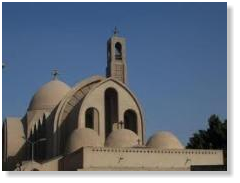
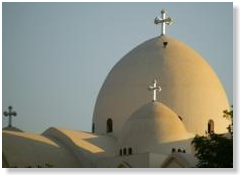
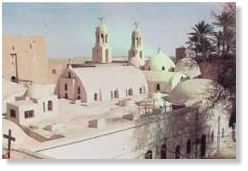
Found Inside and outside Cairo today are many old Coptic Churches and
Cathedrals and several others belonging to different rites. “Daher” district is
especially famous for the number of churches and chapels found there dating back to
different times.
The Virgin Mary Coptic Church in Zamalek, also called the Mara’ashly Church.
The most famous churches in Cairo are the Virgin Mary Church in Zamalek and
St George’s Church in Heliopolis. Both were built by well-known Architect, Ramses
Wessa Wassef. Also, another famous church is Al Adra Church (Virgin Mary) in
Zaytoon. This got its exceptional fame from the events of April 2, 1968 when the
Virgin St. Mary appeared to the crowds every night for over two months. The
sightings were confirmed by thousands of Copts and Muslims. Hundred of miracles
were reported. Right now there are two churches: the old small church where the
appearances happened, and a newly built Cathedral.
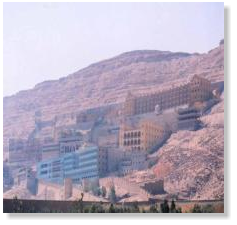
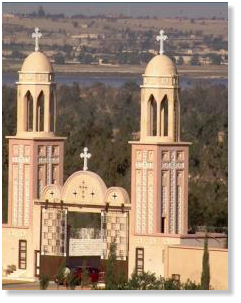
Of course, there remain many monasteries, including some that are very
ancient. Probably the most famous of these are the ones located in the Wadi Natrun
and in the Eastern Desert.
It should be noted that among the Copts a small minority are in communion
with the Pope of Rome; these “Catholic Copts” have their own organization and
churches but share the rites and practices of the Coptic Church. There are also many
Catholic Syrians, mainly Maronites
One final note. Though much has been said about problems between the Copts
and Muslims in Egypt, most of this comes from outside the country. Internally, most
Copts and Muslims seem to agree that the two religions are very united in Egypt,
and indeed, they share more than a few common customs and traditions.





















© Copyrights 2012 St Mina & St Marina Coptic Orthodox Church | All Rights are Reserved | Powered by MultitalentIT


